$100 Oil, Rising Inflation, and What It Means for Gold
Hunter Rhodes | March 2026 | Atlanta Gold & Coin
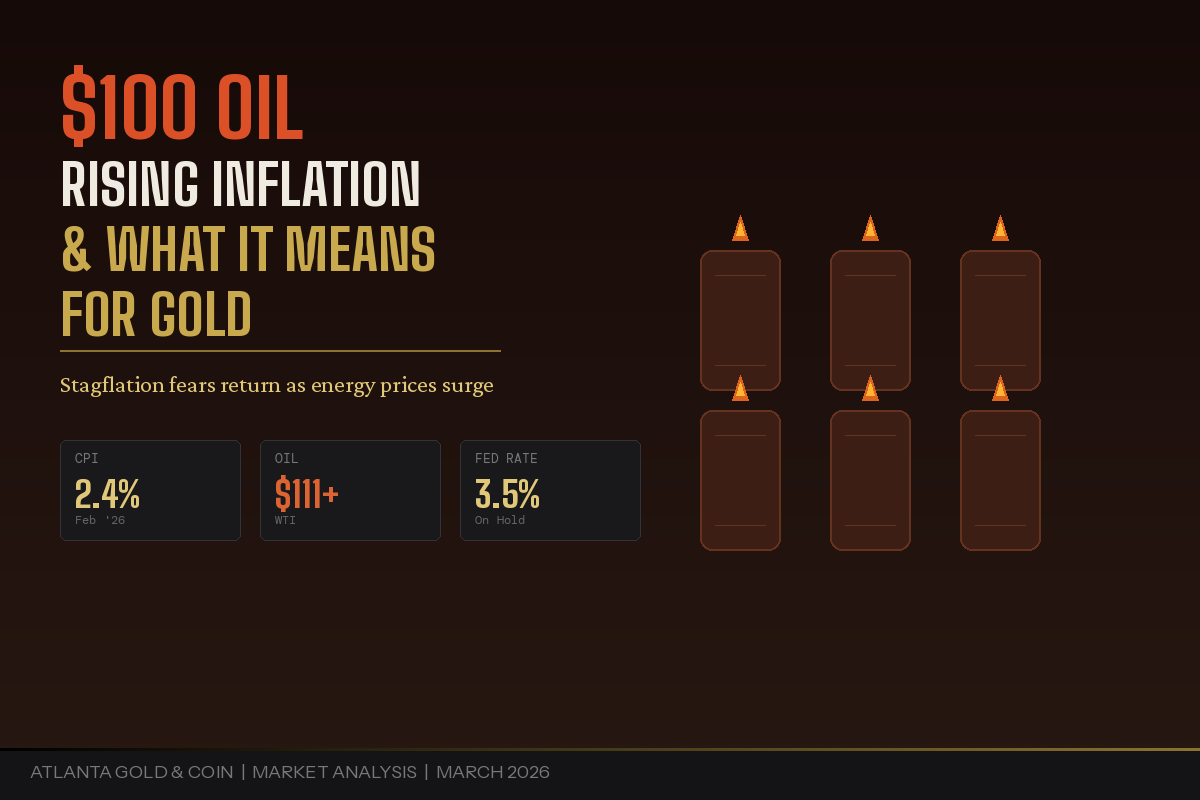
Oil just crossed $100 per barrel for the first time since July 2022. If you're a gold or silver holder, that headline might sound alarming at first — but if you understand the relationship between energy prices, inflation, and precious metals, it's actually one of the most bullish developments for your holdings in recent memory.
Let's break down what's happening, why the Federal Reserve is trapped, and what this stagflationary setup means for gold and silver prices going forward.
Why Oil at $100 Changes Everything
The Iran conflict has disrupted roughly 20% of the world's oil supply flowing through the Strait of Hormuz. Brent crude posted a 27% weekly gain — its biggest since the pandemic — and WTI crude has blown past $111 per barrel. Gas prices are already climbing toward $4 per gallon nationally, and they'll go higher if this persists.
Here's why that matters for metals: higher oil feeds directly into inflation. Barclays estimates that a sustained 10% rise in crude adds roughly 0.2 percentage points to headline CPI within one to two months. RBC Economics projects that if WTI settles near $100, headline inflation could push back above 3% and stay there through 2026. And the February CPI data released this week — which came in at 2.4% annually — doesn't yet reflect any of the war-driven energy price increases. March's numbers are going to be significantly worse.
Moody's chief economist Mark Zandi put it bluntly: if oil stays near current levels, gasoline approaches $4 per gallon, inflation accelerates, and it hits consumer spending, GDP, and jobs. That's the textbook definition of stagflation — slow growth combined with rising prices. And stagflation is historically one of the best environments for gold.
The Fed Is Trapped — And That's Bullish for Gold
The Federal Reserve is now in what economists call a "no-win situation." Higher oil prices are an inflationary supply shock — they push prices up while simultaneously slowing economic growth. The Fed's traditional tools don't work well against supply shocks. If they raise rates to fight inflation, they crush an already weakening economy. If they cut rates to support growth, they risk letting inflation run even hotter.
Before the Iran war, futures traders were pricing in a June rate cut. That's now been pushed to September at the earliest, with no second cut expected in 2026. The implied fed funds rate by year-end has dropped to 3.21% from its current 3.64%, reflecting a market that expects the Fed to mostly sit on its hands.
For gold, this is a supportive backdrop. Gold thrives when real interest rates — the difference between nominal rates and inflation — are negative or declining. With inflation potentially heading back toward 3% and the Fed unable to raise rates aggressively, real rates are likely to remain negative for the foreseeable future. That's exactly the environment that has fueled every major gold rally of the past 50 years, from the 1970s oil crises to the post-2008 financial crisis era.
The 1970s Parallel Everyone Is Talking About
The comparisons to the 1970s are impossible to ignore. You have a major oil supply disruption driven by Middle Eastern conflict. You have inflation already above the Fed's target. You have a weakening labor market — the U.S. lost 92,000 jobs in February. And you have a central bank that's constrained in its ability to respond.
During the 1970s oil crises, gold went from $35 to over $800 per ounce. We're not predicting a ten-fold increase from here, but the pattern is instructive: when energy-driven inflation collides with economic weakness, gold doesn't just hold its value — it outperforms almost everything else. As we discussed in These Five Factors Affect the Price of Gold and Silver, inflation and economic uncertainty have always been among the most powerful tailwinds for precious metals.
What About Silver?
Silver is in an interesting position during an oil shock. On one hand, it benefits from the same inflationary safe-haven dynamics as gold. On the other hand, if the oil shock triggers a significant economic slowdown, silver's industrial demand — which accounts for more than half of total consumption — could come under pressure.
That said, silver's most important industrial demand drivers — solar energy and AI infrastructure — are less sensitive to oil prices than traditional manufacturing. Solar installations are driven by government mandates, utility contracts, and long-term capital expenditure plans, not by short-term economic cycles. In fact, higher oil prices could actually accelerate the push toward renewable energy, indirectly boosting silver demand over the medium term.
The net effect? Silver is likely to be more volatile than gold during this period, but the overall direction should remain upward. As we explained in The Price of Gold Leads, but Silver Stampedes in a Bull Market, silver has a long history of outperforming gold on a percentage basis once a bull market is firmly established.
What Should You Do Right Now?
If you own gold and silver, the $100 oil environment is exactly the kind of scenario that validates your investment thesis. The purchasing power of the dollar is being eroded by inflation that the Fed can't easily control, and your metals are doing what they've always done — holding and increasing their value while paper assets struggle.
If you're thinking about selling, the combination of elevated spot prices and war-driven demand means the market is offering historically strong prices for physical gold and silver. We're seeing clients take advantage of these levels to realize significant gains on holdings they've accumulated over years.
If you're looking to buy, don't let the current price levels scare you away. The macro setup — persistent inflation, negative real rates, central bank buying, and geopolitical fragmentation — suggests that today's prices may look cheap in hindsight. As we wrote in Why Waiting for Gold & Silver Prices to Bottom is the Wrong Approach, the bigger risk isn't buying a bit high — it's missing the structural move entirely.
Ready to buy, sell, or get an appraisal?
We offer transparent, spot-based pricing with no hidden fees. Whether you have a single coin or a full collection, our team is here to help.
Atlanta Gold & Coin — 11555 Medlock Bridge Road #100, Johns Creek, GA
Call us: (404) 236-9744 | Schedule an Appointment
The Bottom Line
Oil at $100 isn't just an energy story — it's a gold story. Rising energy costs feed inflation, inflation traps the Fed, a trapped Fed supports negative real rates, and negative real rates are rocket fuel for precious metals. The stagflationary setup that's forming right now is the most bullish macro environment for gold and silver we've seen since the 1970s.
Whether the Iran conflict resolves in weeks or drags on for months, the inflationary aftershocks will persist. Oil infrastructure doesn't come back online overnight. Consumer price expectations, once they shift upward, take months to reverse. And the Fed's credibility problem — already strained by years of above-target inflation — will only deepen.
Gold above $5,000 and silver above $80 aren't aberrations. They're rational pricing in an irrational world. And if $100 oil becomes the new normal, even for a few months, both metals have significantly more upside ahead.
Atlanta Gold & Coin Buyers has been helping clients buy and sell gold, silver, platinum, palladium, and certified coins since 2010. Located in Johns Creek, Georgia, we serve clients locally and nationwide. Contact us today for a free consultation.